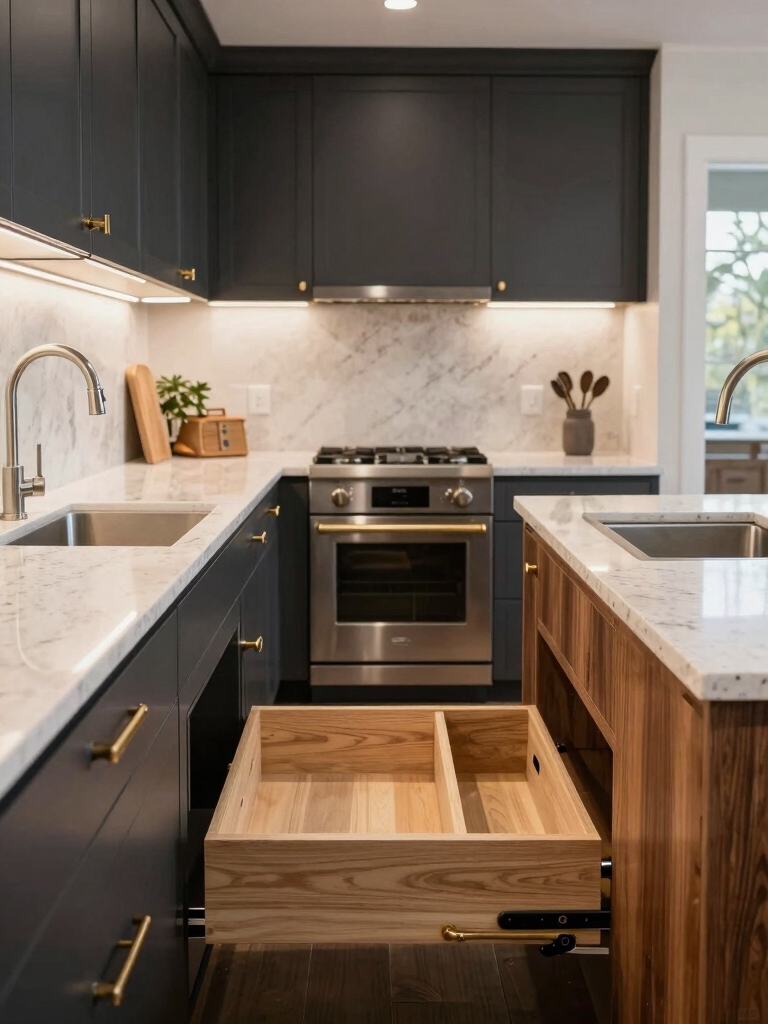

I help homeowners tame split-level kitchens by clarifying circulation, smoothing riser changes, and anchoring sightlines with aligned islands and continuous flooring. I favor short, consistent steps with edge lighting and handholds, cantilevered landings that double as storage, and layered lighting to balance ceiling shifts.
Built-in banquettes and staggered island overhangs create social pauses without blocking flow. I prioritize durable, water-resistant finishes and phased systems work. Keep going and you’ll see practical layouts, materials, and safety fixes.
Assessing the Split-Level Layout and Circulation

Because split-level homes hinge on staggered planes, I first map how people actually move through the kitchen and between levels before I sketch anything else.
I note entry points, sightlines, and natural pauses—stair landings, prep zones, and snack nooks.
Then I test circulation paths for safety and efficiency, balancing traffic flow with work triangles and flexible seating without forcing uniformity.
Island layouts often redefine how a kitchen functions by creating focal points and flexible work surfaces, so I consider how an island kitchen might alter both circulation and social interaction.
Creating Visual Continuity Between Levels

When I want a split-level kitchen to feel cohesive with the adjacent floors, I focus on a few visual threads—materials, sightlines, and scaled shifts—that guide the eye and calm the step changes.
- Match tone with consistent flooring.
- Use a continuous color band.
- Align islands and counters with sightlines.
- Scale lighting and trim to bridge heights.
These choices make shifts feel intentional and calm. I also borrow strategies from ranch kitchen remodels to open up the space and improve flow.
Reconfiguring Steps and Landings for Safety and Flow

I’ll walk you through practical ways to reconfigure steps and landings so your kitchen flows and feels safer.
We’ll look at standardizing riser heights, options for enlarging landings, and strategies for creating seamless level shifts.
With a few measured changes you can reduce trips and make movement between levels effortless.
Consider small kitchen extension ideas that add value by improving circulation and creating more functional landing space for safer transitions, as many architects recommend small kitchen extensions.
Step Height Standardization
If we want a kitchen that feels safe and effortless to move through, standardizing step heights is one of the most impactful changes I can make; uneven rises are a common culprit behind stumbles and awkward flow in split-level kitchens.
I assess, adjust, and refine with practical elegance:
- Measure each rise precisely
- Target a consistent height
- Add subtle nosing for grip
- Verify rhythm by walking
Small, focused updates can deliver big improvements on a modest budget, especially in Cozy Galley renovations where dollars must stretch.
Landing Enlargement Options
Because a cramped landing invites missteps and disrupts the kitchen’s flow, I often start landing enlargement by sketching how people actually move through the space.
I prioritize sightlines, clear circulation, and a generous tread depth. Sometimes I cantilever a wider platform or shift a nearby cabinet.
The goal: safer, intuitive passages that feel curated, not retrofit.
Open concept renovations for split level kitchens often guide these choices, helping integrate stair adjustments with overall kitchen flow and sightlines open concept transformations.
Seamless Level Transitions
I start by tracing how people actually cross those level changes, then rethink steps and landings as parts of a continuous, legible route rather than isolated hazards.
I propose subtle grade shifts and unified materials to guide movement, prioritizing sightlines and handholds.
- Smooth tread changes
- Expanded, visible landings
- Integrated railings
- Consistent lighting and texture
Seamless kitchen islands often act as anchors that enhance flow by reinforcing visual continuity and circulation paths.
Opening Sightlines With Strategic Wall and Ceiling Changes

Although split-level homes can feel chopped into small zones, I’ve found that modest wall and ceiling changes can dramatically reopen sightlines and make the whole space read as a single, connected area.
I remove nonstructural partitions, lower bulky soffits, and introduce thin-profile beams or glass to define zones without blocking views.
The result feels airy, intentional, and visually continuous across levels.
Seamless integration of the kitchen and living room around an island enhances flow and social interaction with a central gathering focus.
Level Transitions Using Short Riser Steps and Platform Solutions

I’ll walk you through how short riser steps can make a split-level kitchen feel intentional instead of awkward, focusing on proportions, tread depth, and material choices that keep sightlines clean.
Then we’ll look at platform shifts — small landings, rail details, and level changes that double as storage or display without breaking flow.
I’ll show precise options so you can pick a solution that’s safe, stylish, and fits your layout.
Short Riser Step Design
Balancing form and function, I prefer short riser steps when bridging level changes in split-level kitchens because they keep shifts safe and visually clean without swallowing ceiling height or kitchen floor area.
I focus on rhythm, sightlines, and material contrast:
- Subtle riser height
- Non-slip treads
- Integrated lighting
- Coordinated trim
These choices feel modern, compact, and reassuring.
Platform Transition Details
When I design platform shifts around short riser steps, I treat the platform as both a functional landing and a visual pause that organizes movement and sightlines.
I specify shallow risers, non-slip finishes, and subtle edge lighting, then layer materials to anchor zones.
The platform becomes a mini-stage—clear changes, storage integration beneath, and calibrated heights that respect ergonomics and aesthetic rhythm.
Zoning the Kitchen for Work, Socializing, and Transition Spaces
Although a split-level kitchen often forces compromises, I’ve found that clear zoning keeps the space working for everyone: designate a focused work zone for cooking, a convivial social zone for eating and chatting, and a deliberate passage area to bridge levels and control traffic.
I use these tactics:
- Task-specific counters
- Defined seating cluster
- Visual cues and lighting
- Durable floor paths
Integrating Islands With Split-Level Traffic Patterns
Against a split-level backdrop I treat an island like a traffic conductor: it should direct flows, create pause points, and protect work zones without becoming a bottleneck.
I position islands to channel stair and hallway paths, carve clear circulation lanes, and add staggered overhangs for casual seating.
Thoughtful walkways, varied heights, and visual cues keep movement smooth and moments of gathering comfortable.
Optimizing Storage for Irregular Walls and Nooks
I carry the same choreography I use for islands over to storage: in split-level kitchens, odd walls and tucked nooks aren’t problems to hide but opportunities to organize smarter.
I sketch custom shelves and modular units, then deploy:
- Floating staggered shelves
- Narrow pull-out pantries
- Corner lazy Susans
- Built-in benches with drawers
You’ll get layered, accessible storage that reads intentional and lively.
Choosing Durable Materials That Read Across Levels
I’ll walk you through choices that make the whole split-level feel intentional, starting with flooring shifts that stand up to traffic and visually link each plane.
I favor materials and thresholds that resist wear but still let the eye travel—think continuous grain or complementary tones.
For cabinets, we’ll prioritize moisture-resistant finishes so your lower and upper zones stay beautiful through spills and steam.
Durable Flooring Transitions
Think about the way your flooring greets you as you move between levels—consistent materials make a split-level kitchen feel intentional instead of patched together.
I pick durable junctions that read across rooms, balancing texture and resilience. Consider:
- Continuous hardwood with relief joints
- Large-format porcelain bridging zones
- Vinyl plank with matching grout lines
- Metal threshold for modern contrast
Moisture-Resistant Cabinetry Finishes
Usually I choose cabinetry finishes that can take a spill, a steam session, and the occasional mop with equal calm, because moisture doesn’t respect level changes.
I favor water-resistant paints, thermofoil, and sealed veneers that read consistently across stair risers and lower runs.
They resist swelling, clean easily, and pair with trim details so transitions feel intentional—practical, pattern-smart, and quietly eclectic.
Lighting Strategies to Balance Multiple Ceiling Heights
Although split-level kitchens throw a handful of challenges at you, I’ve found that smart lighting design can actually turn staggered ceilings into an advantage—drawing the eye, defining zones, and balancing scale.
I recommend:
- Layer ambient with recessed cans.
- Accent pendant clusters over islands.
- Wall washers to lift low areas.
- Dimmable zones to unify varied heights and moods.
Aligning Plumbing and Mechanical Systems During Reconfiguration
Lighting sets the mood, but plumbing and mechanical systems make the kitchen liveable — so when you reconfigure a split-level layout, you’ll want to align those systems with the new plan from the start.
I map supply lines, vents, and drainage to minimize runs, balance load, and avoid invasive work.
I coordinate with engineers early, prioritize access panels, and favor flexible connections for future tweaks.
Using Color and Finish to Unify Disparate Spaces
I lean into color and finish to pull split-level zones together, choosing threads—a shared paint tone, a repeated metal, or a consistent wood stain—that guide the eye and calm shifts.
- Harmonize wall hues to link rooms.
- Repeat a metal for fixtures.
- Use one wood stain for cabinetry.
- Layer textures to balance contrast and keep shifts intentional.
Incorporating Built-In Seating and Window Seats on Mid-Levels
I’m excited to show how a compact mid‑level can do double duty with built‑in seating that respects the footprint while adding clever storage beneath.
I’ll point out simple layout moves that tuck drawers and shelves into benches and explain how lighting and trim can frame a window seat’s view like a picture.
Together we’ll make those small landings feel intentional, bright, and utterly useful.
Optimizing Mid‑Level Footprint
When you work with a split-level kitchen, maximizing the mid-level footprint can make the whole space feel smarter and more intentional, so I favor built-in seating and cozy window seats that tuck into niches without eating traffic flow.
I focus on scale, sightlines, and dual-purpose edges:
- Slim banquette
- Corner window seat
- Foldaway table
- Low-profile cushions
Integrated Storage Solutions
Because mid-levels are all about pockets of space that need purpose, I design built-in seating and window seats to double as discreet storage so every inch works harder.
I layer cushion fabrics, mixed woods, and hidden drawers to store linens, small appliances, or pantry overflow.
These seating nooks become organized grab-and-go zones, visually rich and practical without feeling cluttered or fussy.
Lighting and View Framing
Although mid-level nooks are small, I treat them like a stage where light and sightlines set the scene — built-in seating and window seats become focal anchors that frame views, bounce natural light into the kitchen, and create intentional pauses between levels.
I sketch solutions that balance function and drama:
- layered task and ambient lighting
- low sills for view framing
- storage under benches
- coordinated materials to unify levels
Accessibility Improvements for Aging in Place on Split Levels
If we’re planning a split-level kitchen remodel with aging-in-place in mind, I focus first on how people will move between the different levels: steps, landings, and short shifts are where trips and strain show up fastest.
I prioritize shallow risers, continuous handrails, contrasting step edges, gentle ramps where possible, non-slip surfaces, good sightlines, and reachable counters—small moves that add independence and dignity.
Budgeting and Phasing a Split-Level Kitchen Remodel
I start budgeting a split-level kitchen remodel by mapping the project into clear phases tied to the house’s vertical layout—what gets done on the landing, the upper prep zone, and the lower dining or utility area—and I assign realistic costs and timelines to each phase so surprises stay small and manageable.
- Site assessment
- Structural and systems
- Finish packages
- Furnishings and contingencies
I’ve lived through enough split-level puzzles to promise this: you can tame the steps, stitch sightlines, and make mid-level nooks sing — without turning your house into a museum of mismatched ideas.
Think small moves with big rhythm: a short riser, a continuous color note, a built-in bench that winks. Do it in smart phases, spend where it counts, and your kitchen will feel like it always belonged — only bolder, friendlier, and undeniably clever.